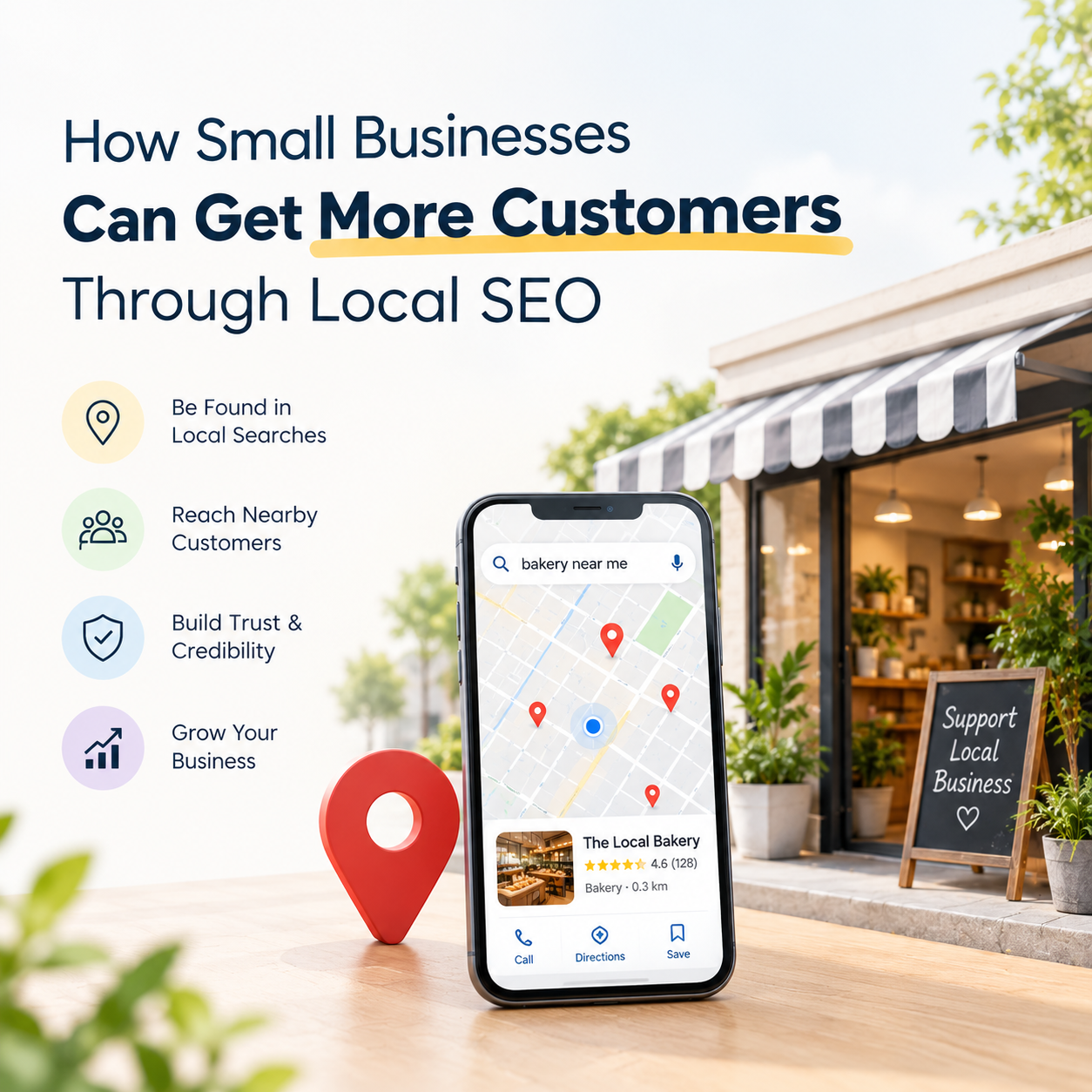
How Can Small Businesses Get More Customers Through Local SEO?
Finding new customers for a small business may not be an easy thing to do. Even if a business offers great products or services, has a well-working team and good customer experience, the residents of the area still might not be able to find the business on the internet.
Imagine how people act when they look for such things like “dentist near me”, “best restaurant in Indore” or “plumber in my area”. Most often, they need to find a business nearby that will suit them. When a business shows up among the search results, there is a higher possibility to attract customers.
That’s where the importance of local SEO for small businesses comes into play. Local SEO makes businesses more visible to their customers from nearby locations via search engines.
Here is our guide about the local SEO of small businesses and how to use it for attracting local customers.
Why Is Local SEO Important for Small Businesses?
A small-scale enterprise always works with a constrained budget, especially related to the sphere of marketing. It requires a way to connect with customers who really require one’s products or services.
And here is where local SEO can help one in connecting with people who have already shown interest in the products/services one is selling.
There are several advantages to using it.
Helps Customer Find Your Business on the Internet
When a customer wants to buy a product or use a certain service, he/she usually starts by conducting a search in Google. And if one’s business is optimized properly, it has a great chance of appearing in relevant local search results.
For example, a person who searches for “AC repair service in Indore” can find local companies that provide such services thanks to Google Search or Google Maps.
One can attract more clients simply due to his/her business being correctly represented on the Internet: the location of the office should be clear, as well as the type of services offered.
Connects Businesses with People with Buying Intentions
One cannot consider all Internet visitors as prospective clients, and not all website users are ready to purchase something right now.
Creates Trust and Credibility
It is common practice to verify the review ratings, pictures, address, contact information, and website of a business before reaching out to it.
A complete Google Business Profile, authentic reviews, and accurate business information can increase a customer’s level of trust for a particular business.
Local SEO cannot create any form of trust but will make essential information easily accessible and accessible.
Assists Local Businesses with Local SEO
Local businesses might find it hard to compete with well-known companies in relation to general keywords. But it can narrow its focus on local searches, local services, and local people.
In other words, rather than using a broad keyword such as “interior design,” the interior designer can use a specific term such as “Home interior designer in Indore.”
7 Ways Small Businesses Can Get More Customers Through Local SEO
Local SEO involves several activities that work together. You do not need to implement everything at once. Start with the basics and improve your online presence gradually.
1. Optimize Your Google Business Profile
A Google Business Profile is one of the most useful tools for local businesses. It allows eligible businesses to display important information on Google Search and Google Maps.
When people search for your business or related services, your profile can help them find details such as your address, phone number, business hours, photos, reviews, and website.
To improve your Google Business Profile:
- Use your correct business name.
- Select the most relevant primary business category.
- Add accurate business hours, contact details, and location information.
- Describe your products and services clearly.
- Upload genuine photos of your business, team, products, or completed work.
- Add relevant services where the feature is available.
- Keep your profile updated when business details change.
- Respond professionally to customer reviews.
For example, a salon in Indore should clearly communicate the services it offers, its operating hours, and how customers can book an appointment.
Avoid adding unnecessary keywords to your business name. Your profile should reflect your real business information rather than being created solely to influence rankings.
2. Use the Right Local SEO Keywords
Keywords help search engines understand what your website pages are about. For local businesses, combining a service with a relevant location can help attract more specific searches.
Consider a business that provides plumbing services in Indore.
Its relevant keywords might include:
- Plumber in Indore
- Plumbing services in Indore
- Emergency plumber in Indore
- Bathroom plumbing repair in Indore
- Residential plumbing services near me
These phrases reflect different customer needs and search intentions.
To find suitable local SEO keywords, start by thinking about the questions customers ask, the services they need, and the locations you actually serve. You can also use Google Search suggestions, Google Search Console, and keyword research tools to discover relevant queries.
Use these keywords naturally in your page titles, headings, service descriptions, and website content. Avoid repeating the same phrase unnecessarily.
The goal is not to add as many keywords as possible. It is to make your content relevant and useful to people searching for your services.
3. Create Location-Specific Website Pages
If your business serves multiple locations, dedicated location pages can help explain which areas you cover.
For example, an interior design company serving Indore, Bhopal, and Ujjain could create separate pages for each city, provided each page offers genuinely useful and distinct information.
A good location page should include:
- The services available in that area
- Relevant contact or enquiry details
- Genuine project examples or local experience, where available
- Information about the areas served
- Answers to common customer questions
- Clear and accurate page titles and headings
Avoid creating dozens of nearly identical pages by changing only the city name. Such pages provide little additional value to visitors.
Each page should help customers understand how your business serves their particular location.
4. Collect Genuine Customer Reviews
Customer reviews can influence how people evaluate a business before contacting it. They also provide useful feedback that businesses can use to improve their services.
Encourage satisfied customers to share honest reviews through your Google Business Profile. You can ask for feedback after completing a service or delivering a product.
When responding to reviews:
- Thank customers for sharing their experiences.
- Address concerns politely and professionally.
- Avoid sharing private customer information.
- Respond to negative feedback constructively.
- Never purchase fake reviews or offer incentives in exchange for positive ratings.
Reviews are not simply about achieving a high star rating. Genuine feedback helps potential customers understand what they can expect from your business.
5. Make Your Website Mobile-Friendly
Many people search for local businesses using their smartphones, especially when they need a service quickly.
If your website is difficult to navigate on a mobile device, visitors may struggle to find your phone number, service details, or enquiry form.
A mobile-friendly website should have:
- Fast and reliable loading
- Readable text without unnecessary zooming
- Easy-to-use navigation
- Clickable phone numbers where appropriate
- Simple contact and enquiry forms
- Clear service information
- Secure HTTPS connections
Website performance also matters. Review your loading speed, mobile usability, and Core Web Vitals to identify technical issues that may affect the user experience.
A good mobile experience helps visitors find information quickly and makes it easier for them to contact your business.
6. Create Helpful Content Around Local Customer Needs
Regularly publishing useful content can help your website answer questions that potential customers search for.
Instead of writing only about your business, think about the problems your customers want to solve.
For example:
A dental clinic could publish articles about choosing a dentist, understanding common dental procedures, or maintaining oral hygiene.
A home interior designer could write about small-home design ideas, room planning, or choosing materials for different budgets.
A coaching institute could answer questions about course selection, entrance examinations, and study preparation.
This type of content helps build topical relevance and gives visitors useful information before they contact you.
When appropriate, include local context, examples, and links to relevant service pages. Avoid adding city names to articles where they do not contribute anything meaningful.
The aim is to answer real customer questions, not simply to publish blogs for the sake of having more content.
7. Maintain Consistent Business Information Across the Web
Your business name, address, phone number, and other important details should be accurate wherever your business is listed online.
These details may appear on your website, Google Business Profile, local directories, industry listings, and social profiles.
Inconsistent information can confuse potential customers and make it harder for them to contact you.
To maintain consistency:
- Use the correct business name and contact information.
- Keep your address updated when your business moves.
- Correct outdated phone numbers and opening hours.
- Review important business directory listings periodically.
- Remove or update duplicate and incorrect listings where possible.
Consistency is a useful part of local SEO management, although it does not guarantee higher rankings by itself.
How Long Does Local SEO Take to Show Results?
It is an incremental process, and the time taken by every business to reach its goal varies.
Some changes, like correcting the opening hours and contact details, could be beneficial for customers right away. Visibility and ranking through local searches may take time.
The time varies depending upon some factors, such as:
- Industry and the degree of local competition
- Present condition of the website
- Completeness of your Google Business Profile
- Relevancy of the content
- Location and coverage of services provided by your business
- Strength of local business competitors
Instead of waiting for immediate outcomes, monitor your progress and work on improvements that could benefit your customers.
How Can You Measure the Results of Local SEO?
To understand whether your local SEO efforts are working, track both visibility and customer actions.
Here are some useful metrics:
Google Business Profile performance: Review available metrics such as searches, profile views, calls, website clicks, and direction requests.
Google Search Console: Monitor search queries, impressions, clicks, click-through rate, and average position for relevant pages and location-based keywords.
Google Analytics 4: Track website visits, enquiry form submissions, and other important conversion events when these are configured correctly.
Customer enquiries: Monitor calls, appointment requests, bookings, and enquiries that originate from local search.
Local keyword visibility: Check how your website performs for relevant searches in your target locations. Rankings can vary depending on location, device, and search context.
Looking at several metrics together provides a more useful picture than focusing on rankings alone. For example, a page may receive more impressions but still need improvements to attract clicks or generate enquiries.
Common Local SEO Mistakes Small Businesses Should Avoid
Even businesses that invest time in SEO can make mistakes that limit their progress.
Some common issues include:
- Leaving the Google Business Profile incomplete or outdated.
- Choosing business categories that do not accurately describe the services offered.
- Repeating local keywords unnaturally throughout website content.
- Creating duplicate or low-value location pages.
- Ignoring customer reviews and questions.
- Using incorrect contact details across business listings.
- Publishing generic blogs without addressing customer needs.
- Expecting guaranteed first-page rankings or immediate results.
- Tracking website traffic without measuring meaningful customer actions.
Avoiding these mistakes helps create a more reliable online presence and a better experience for potential customers.
Final Thoughts
Local SEO as a method of acquiring customers is about making it easy for potential customers who need your goods or services in the area to find you online.
The basics include correct business information, fully completed Google Business Profile, keywords and mobile-friendly website. On top of the basics, you should get real customer reviews, create good content, and track your performance.
It is not necessary to try all of these at once – choose those that suit your needs and evaluate the results.
Local SEO is not an easy task, but with patience and customer orientation, it is possible to achieve success with it.
FAQs
Is local SEO useful for small businesses?
Yes. Local SEO can help small businesses improve their visibility in relevant location-based searches. It is particularly useful for businesses that serve customers in specific cities, neighbourhoods, or service areas.
Is Google Business Profile enough for local SEO?
A Google Business Profile is an important part of local SEO, but it is not the only factor. A well-maintained website, relevant local content, accurate business information, and genuine customer reviews can also support a business’s online presence.
Can a small business rank on Google without a physical shop?
Yes, certain service-area businesses can appear in relevant local search results without serving customers at a storefront. Eligibility and profile setup depend on Google’s guidelines. Businesses should represent their actual operations accurately and must not create fake locations.
What are local SEO services?
Local SEO services generally involve activities such as Google Business Profile optimization, local keyword research, website optimization, location-page development, citation management, review management, and performance tracking. The exact scope depends on the business’s needs.
How much does local SEO cost?
The cost of local SEO services varies according to the location, competition, number of service areas, website condition, and amount of work required. Some businesses manage basic activities themselves, while others choose professional assistance for ongoing optimization.
Do customer reviews improve local search rankings?
Reviews are one of the factors Google considers in local ranking, alongside relevance and distance. Prominence also matters. Genuine reviews can support customer confidence, but positive reviews alone cannot guarantee a particular ranking.