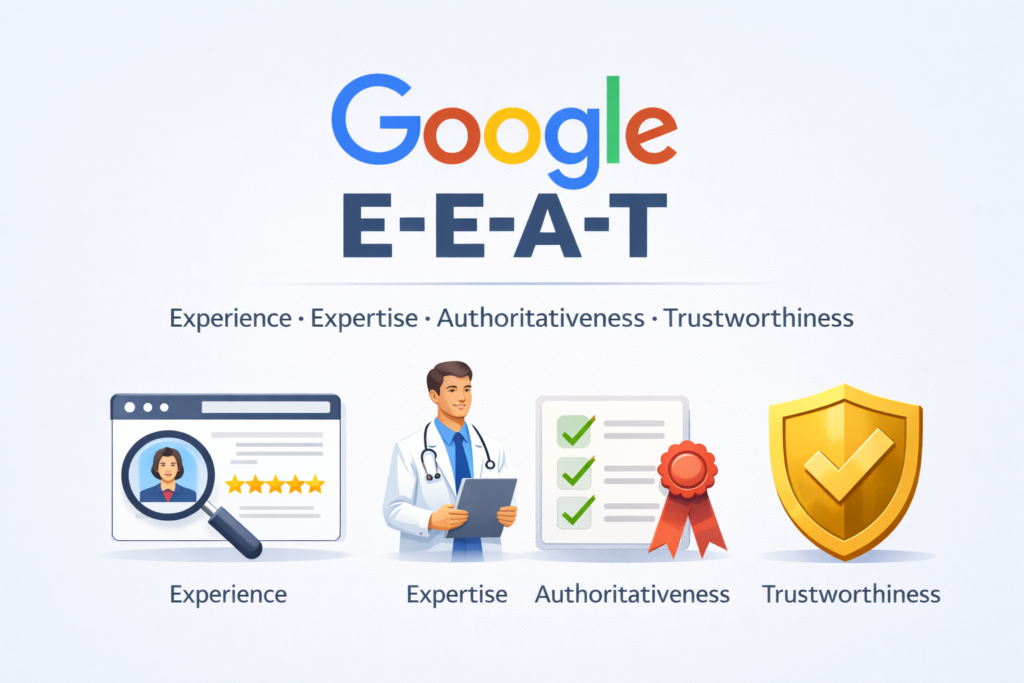
EEAT Explained: How Google Decides Which Brands to Trust
EEAT Explained: How Google Decides Which Brands to Trust If you are looking to get SEO services in India or if you are going to hire a SEO agency, you might have come across EEAT. But what is EEAT really, and why are all digital marketing professionals discussing it? These days, Google does not rank websites based on keywords only. It looks for content that is useful, credible, and factual to its users. That is why EEAT is very important. If you get a good grasp of this concept, it will lead to better decisions in getting the best SEO services and expanding your online presence in the right manner. We can explain it in a very simple and interesting way. What Is EEAT? EEAT stands for Experience, Expertise, Authoritativeness and Trustworthiness.It is derived from Google Search Quality Evaluator Guidelines, a guideline for human assessors to rate the quality of content. Though EEAT as a concept cannot be seen as a direct Google ranking factor that can be measured or influenced like backlinks or page speed, still it carries significant weight in the manner Google assesses websites overall. The idea is quite straightforward. Google aims at giving the highest rankings to content created by reliable and knowledgeable people. With your brand being a strong EEAT signal, it is quite probable that you will get higher rankings in search results. Such a method cannot be successful now. Nowadays, search engines consider user behavior on your website when they make their assessment. If visitors cannot find what they are looking for, they will leave. If content is artificial or superficial, it will be penalized in the rankings. The latest algorithms can detect and quickly get rid of low value content patterns. That is the reason why many companies are disappointed after spending money on SEO. The issue is not SEO itself, the issue is sticking to the old ways. Why EEAT Matters for Businesses in India The fast expansion of online businesses in India has led to a very competitive market. No matter if you are a small new business or a big company, partnering with a professional SEO agency in India can be a great way to create powerful EEAT signals. Google particularly pays attention to EEAT for websites dealing with topics that significantly affect people’s health, money, or safety. These are the so-called “Your Money or Your Life” topics. However, even ordinary business websites need to prove that they are trustworthy and reliable. Without trust signals on your website, even the best-looking website and use of keywords will not be sufficient to achieve sustained success. Usually, people who search for “best seo services” are at the stage of picking one from the few, judging the level of professionalism, and looking for the signs of trust. On the other hand, a searcher of “SEO services in India” is likely to be looking into agencies, pricing, and long term value. Therefore, if the focus of your content is different from their needs, then no matter how well optimized your site is, it would not rank. Because of this change, SEO has become less of a game and more of a real dialogue. Understanding Each Part of EEAT In order to get the full advantages of EEAT, it is necessary to grasp each element separately. The first element is Experience. It is known that content written by a person who has actually used a product or a service receives preference from Google. Content becomes more authentic when it is backed up by real-life examples, case studies, and the author’s personal insights. For instance, a blog about digital marketing written by a specialist in an SEO agency will come across as more genuine compared to a generic piece of content. Second is Expertise. It is the knowledge and skills of the person producing the content that are relevant here. So if your website deals with technical SEO, it should be evident that it is coming from someone who is well-versed in the field. This is the reason why companies sometimes hire the top SEO services to write high-quality, informative content. The third one is Authoritativeness. This is down to your reputation. Do other trustworthy websites refer to your brand? Have you got good reviews? Is your content being cited by industry experts? Authority is something that develops over time through continuous efforts and quality work. Last but not least comes Trustworthiness. The main factor here is trustworthiness. Your site needs to offer straightforward contact details, have safe ways of making payments, display clear policies, and feature honest content. Trust is the foundation of loyalty and long-term success. How Google Evaluates Trust To know if a brand is trustworthy, Google employs multiple cues. Some of those are backlinks from reputable sites, customer reviews, correct information, and consistent branding. Take the case of Google, a company that regularly changes its algorithms to increase the visibility of helpful content and lower that of spam. Among the most important changes, the Google Helpful Content Update is tailor-made to give a boost to people-first content. If your site genuinely helps visitors instead of just trying to rank for keywords alone, you have already taken a step in the right direction. How an SEO Agency Helps Build EEAT Building an EEAT is a long-term project. It means strategy, consistency, and knowledge. A professional SEO agency knows how to bring content, technical SEO, and brand reputation in line with Google’s expectations. Here are some ways the top SEO services help EEAT: Producing high-quality, deeply researched content by subject matter experts Author profiling and company information optimization Getting strong backlinks from relevant and trustworthy websites Enhancing website security and user-friendliness Review management and brand reputation Partnering with a seasoned SEO agency in India means that you are not only putting money in rankings. You are putting money in trust and steady growth. Practical Tips to Improve EEAT on Your Website Increasing EEAT doesn’t always require a huge budget. You can even
EEAT Explained: How Google Decides Which Brands to Trust Read More »